A long story in the New York Times today (July 4, 2010) about an Iraqi war soldier who became disabled in combat and is learning to reinvent his life. Okay, that's an oversimplification of a complex, touching article. But at some level it is without a doubt a disability tale--and that's where I come in.
Usually, stories of heroic overcomers turn my stomach. First of all, they are clichés. Also, sometimes it seems that anyone who actually lives a life with a disability is treated as heroic, inspirational, miraculous, and so forth. Perhaps we are, but I like to think that's more because of coping with a world that isn't made for us, doesn't get us or welcome us. We're not amazing simply because of having a disability.
There IS a difference.
Still, injured veterans' stories are pretty incredible. (Injured anyone's, for that matter.) The fact is, disabled veterans have always been a huge, if unintentional, impetus to disability rights. Prosthetics and even motorized wheelchairs were invented specifically in reaction to the sudden swell in the disability population caused by wars.
All of which is a lead-in to this excerpt from my book-in-progress:
Mr. Snuffles, as I secretly call him, has a musty workshop on the second floor of a walk-up on the Upper East Side. Dad has to carry me bodily up the stairs.
Once there, Dad lies me down on a vinyl-topped examination table, where I have nothing to do but stare at an assortment of fliers posted on the wall. "Four out of five dentists recommend sugarless gum for their patients who chew gum" one of the signs informs me.
I wonder what it's doing in a prosthetics and orthotics facility!
Decades later I learn that the earliest recorded example of a prosthesis is an iron leg made for one Queen Vishpla, an Indian warrior in 3000 BC, who was amputated in battle yet returned to fight again with her new hardware, according to an ancient Sanskrit text.
Why isn't something like that, emboldening info about the historical importance of assistive technology, posted here?
… I have a new motorized wheelchair—my first—which is too heavy to get up the school steps, but at home I love to zoom around, especially fun in my building's labyrinthine basement.
Gary and I play there after school, staying clear of the housekeepers who do laundry and the maintenance workers who have an office down there as we explore the myriad dark passages and commodious storage lockers, pretending we're on a mystery investigation. It's taken me a while to get an electric wheelchair. They've been mass-produced since 1956, when Everest and Jennings rolled the first one out of its California factories, improving upon designs putatively sketched by George Westinghouse in the late-nineteenth century and British engineers during the First World War, then perfected in the early 50s by a Canadian inventor named George Klein, primarily for World War II vets—demonstrating again the connection between war and disability progress.
The first E & J power chairs were notoriously slow, but in the early-70s they become the vehicle of choice for active quadriplegics—brandished by Ed Roberts and his trendsetting crew in Berkeley. The only reason I didn't have one before is Dr. Spiro, my neurologist, feared it'd make me lazy, make me not use my arms and build arm strength. Now we know I can't build up my muscles, so he finally wrote the prescription.
The first day I get the motorized wheelchair home I chase Alec around our apartment. I'm not a good driver yet and keep crashing, leaving tell-tale gray scratches on the white walls.
(More later.)
Sunday, July 4, 2010


Friday, July 2, 2010
Out of the mouth of babes and sucklings hast thou ordained strength... (Psalms 8:2)
Well, dear reader, I'm clearly not a good blogger (bloggist?).
If done right, a blog should provide new information, or a fresh perspective on old or little-known items, with links to relevant Web sources. You think?
It should incorporate words and pictures and maybe even video clips. Right?
Most of all, it should be updated. Frequently. In fact, the more often, the better. No question.
If all that sounds like a full-time job, that's because it does to me, too. A full-time job without pay.
Which is why this humble blog-manque is so often neglected. Or at least it's my excuse, and I'm sticking to it.
But then, suddenly, the world changes. Or a portion of it. My portion.
Yesterday, I got word from a publisher that he's interested in publishing my book except I don't have the "platform" to push it through his bosses and bottom-line-oriented bureaucracy. Platform, in this case, is really a kind of launching pad--a promotional launching pad to spur book sales to soar. Or as my younger daughter put it recently, "You're not famous, Dad? Why should anyone want to read about you?"
I figure I need a ramp to my platform!
So rather than my traipsing through downtown in the nude, or some other pointless act of sensationalism, this publisher suggested I build an online following. He gave me 6 to 9 months to generate readership--active, dedicated readership--for this, my blog, and/or my Twitter musings. After which, he said, he would like to take a second look at my book proposal.
The thing is, he's not the first potential publisher to say something like this.
The good news is, I don't have to rewrite my manuscript to get it taken seriously. My writing style and content are not the problem. But I have to work harder at this blog business.
If you've gotten this far, kindly click on the FOLLOW button to the right (that is, if you haven't already).
For those of you who have already done that, my humblest gratitude!
So, onto the problem of how to keep feeding my blog while maintaining a career as a freelance journalist ...
Again from the mouth of babes (no offense) came the wise answer!
My elder daughter (and 10 no-prize points to whoever can explain the difference between "elder" and "older") suggested, "Why don't you 'leak' small segments of your book? Just enough to whet readers' appetites..."
And so I shall. Beginning Monday. Stay tuned...
If done right, a blog should provide new information, or a fresh perspective on old or little-known items, with links to relevant Web sources. You think?
It should incorporate words and pictures and maybe even video clips. Right?
Most of all, it should be updated. Frequently. In fact, the more often, the better. No question.
If all that sounds like a full-time job, that's because it does to me, too. A full-time job without pay.
Which is why this humble blog-manque is so often neglected. Or at least it's my excuse, and I'm sticking to it.
But then, suddenly, the world changes. Or a portion of it. My portion.
Yesterday, I got word from a publisher that he's interested in publishing my book except I don't have the "platform" to push it through his bosses and bottom-line-oriented bureaucracy. Platform, in this case, is really a kind of launching pad--a promotional launching pad to spur book sales to soar. Or as my younger daughter put it recently, "You're not famous, Dad? Why should anyone want to read about you?"
I figure I need a ramp to my platform!
So rather than my traipsing through downtown in the nude, or some other pointless act of sensationalism, this publisher suggested I build an online following. He gave me 6 to 9 months to generate readership--active, dedicated readership--for this, my blog, and/or my Twitter musings. After which, he said, he would like to take a second look at my book proposal.
The thing is, he's not the first potential publisher to say something like this.
The good news is, I don't have to rewrite my manuscript to get it taken seriously. My writing style and content are not the problem. But I have to work harder at this blog business.
If you've gotten this far, kindly click on the FOLLOW button to the right (that is, if you haven't already).
For those of you who have already done that, my humblest gratitude!
So, onto the problem of how to keep feeding my blog while maintaining a career as a freelance journalist ...
Again from the mouth of babes (no offense) came the wise answer!
My elder daughter (and 10 no-prize points to whoever can explain the difference between "elder" and "older") suggested, "Why don't you 'leak' small segments of your book? Just enough to whet readers' appetites..."
And so I shall. Beginning Monday. Stay tuned...
Monday, March 29, 2010
Of Dragons and Disabilities

Over the weekend I saw "How To Train Your Dragon," the new DreamWorks cartoon and box office sensation, with my wife and our younger daughter. I'll spare you my rant about wearing 3-D glasses -- and my hope that this latest trend doesn't last.
What I loved about this movie was a completely overlooked, unexpected subplot detail.
Nobody told me there was a disability theme in the story.
One of the main adult characters, the Viking leader's no. 2 guy, is a double-amputee who keeps fighting, one of the bravest and most loyal of all. Not that he's an overcomer super-crip type. He just blends in. In fact, I didn't even notice his replacement limbs until halfway into the movie. Then, the primary cute dragon-cum-pet needs a prosthetic rear wing. Finally--well, I don't want to give away the ending. Let's just say another character acquires a prosthetic aid toward the finale, too, and after a pause it's no big deal. No rousing, uplifting, inspirational hoo-ha, and no tears. It's not glossed over, either, because accommodations must be made (and nobody can make them as well as the injured person himself, which certainly rings true for me). They all work together for the good of the mythical half-Norse, half-Irish (huh?) island kingdom, with full inclusion for those maimed in combat.
Wow! Very cool.
I hope it teaches kids something about the value and acceptability and normality of assistive devices, prosthetics included. You know, in a way the story is dead on. Historically disability and war have always been closely linked. One of the earliest known references to disability-related hardware comes from an ancient Sanskrit text that tells of an Indian warrior named Queen Vishpla, around 3000 BCE. A battle injury led to the amputation of one of her legs. An iron leg was made to replace it, and she returned to fight again. (See the Disability History Timeline)
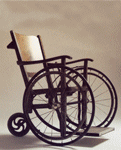 Motorized wheelchairs might not have been invented if not for the veterans of World War II--improving upon designs putatively sketched by George Westinghouse in the late-19th century and, later, British engineers during the first World War, for injured soldiers and civilians. In the early 1950s a Canadian inventor named George Klein supposedly perfected a model motorized wheelchair for WWII vets, which in 1956 became mass-produced by a California folding-wheelchair manufacturer called Everest & Jennings. Though those early chairs were notoriously slow, E&J dominated the wheelchair market for the next 30 or 40 years. (See A Chronology of the Disability Rights Movements)
 So hooray for the understated disabilities theme in the dragon movie! Overall, the story ain't bad either. But next time, if I had it to do over again, I think I'd go for the 2-D version. The tickets are cheaper anyway.
University of Southern California/Rancho Lifestyle Redesign
Saturday, March 27, 2010
How the Mighty (Editors) Have Fallen!
Maybe it's me, but it seems in the midst of the spate of recession memoirs -- a particularly timely sub-genre of coping, a.k.a. triumph-over-tragedy, tales -- the newest, hottest subset is the memoir by an ex-Condé Nast editor.
Absurd? I think not.

Alexandra Penney
www.thedailybeast.com/author/alexandra-penney
If two examples can inaugurate a trend, consider former SELF ed Alexandra Penney's "The Bag Lady Papers" (Hyperion), which is about her financial ruination at the hands of Bernard Madoff, spun off and partially serialized in her blog on The Daily Beast; and Dominique Browning's upcoming "Slow Love: How I Lost My Job, Put on My Pajamas and Found Happiness" (Atlas & Co.), a memoir of the joys of unemployment following the demise of HOUSE & GARDEN magazine, which she had edited for 12 years (she blogs, too, at www.slowlovelife.com).www.thedailybeast.com/author/alexandra-penney
What's especially interesting about these two is the similarity in the women's psyches. As excerpted in this Sunday's New York Times Magazine (March 28, 2010), Browning's book says:
"My nightmare had finally come true. For years, I had a profound dread of unemployment that went way beyond worrying about how to pay the bills. … My anxiety had more to do with my own neuroses …. I always worried that if I didn’t have work, I would sink into abject torpor.... I have always supported myself."

Dominique Browning
www.slowlovelife.com/p/about-dominique-browning.html
Penney expresses something very similar:
"For many years, I've feared that one day I'll wake up and be destitute and alone. ... I will end up trudging the streets, cold and abandoned, with a shopping cart filled with tattered bags full of god knows what. ... In December 2008, my worst nightmare came true."No, even the bit about nightmares coming true doesn't exactly constitute plagiarism. But the overlap is interesting. I suppose these days many people fear unemployment, but this common strain makes me think that some of these very successful people--these hyper-driven women--do what they do and get where they get because of this fear. It spurs them to achieve, and keep achieving. By their own admission, it's an irrational fear out of all proportion to reality. So it must spark an irrational drive that's out of proportion, too.
Back in the 1980s I applied for a job at Condé Nast. Needless to say, I didn't get it or any other. Perhaps if I had, I'd be writing one of those memoirs myself now. Then again, I'm certain I've never had a nightmare about becoming a bag lady, or whatever the male equivalent is.
Anyway, it makes for fun reading!
Thursday, March 4, 2010
Two Elegies
I was beginning to think I was a heartless jerk.
Tragic earthquake in Haiti? Horrible, for sure. But the people there have been suffering since day one, right ... and what does Haiti have to do with me?
Ditto Chile. Sympathy overload.
Or when some people with disabilities like mine urged me to support medical research to fight spinal muscular atrophy--the diagnosis behind my disability, considered the most common cause of genetically based neonatal death--I couldn't be bothered. As you'll hear soon on NPR, I was too busy thinking about the implications of this "cure mentality" on the disability civil-rights struggle to care much about dying babies.
How monstrously selfish could I be?!
But two recent deaths of people near me, in as many months, changed all that. I learned I do have a heart after all.
Sometimes that's what it takes, I guess. You don't appreciate what you have until it's broken.
The first death, at the end of last year, was my childhood housekeeper. Inez was like a second mother to me (perhaps that's unfair to my step-mother, but you get the idea). Though she helped raise my brother and me from infancy through college, I never really knew much about Inez. She was a hard-working uneducated Black woman who loved watermelon, made a mean fried chicken, and spoke a little like the stereotypes in old movies
--but occasionally with a sharp edge that used to frighten me. She could be fiercely opinionated in a Brooklyn sort of way.
In later years, I asked her about her life. She was born in the South--Georgia? Alabama? I'm not sure--and came to Harlem in the 1940s. She had a grown-up son with whom she was in and out of touch. She was proud of having worked in some of the finest homes on Park Ave. (I guess she was slumming with us; we lived on E. 79th at York, and then on Central Park West.)
She moved to Florida a few years ago, after retiring, where she had family. It was one of her nieces who called me with the sad news. She said Inez was 92 when she died (I asked). Inez had always insisted she was 19, year after year.
I found myself thinking about what Inez had seen in her lifetime, especially the changes for African-Americans like herself. I was pleased she had lived to see Barack Obama elected president, though I don't actually know if she voted for him. But I do remember how much she enjoyed watching Sammy Davis Jr. on TV in the 1970s, up there with Frank and Dino, sharing the spotlight with any number of glorified and respected white performers!
I wanted to go to her funeral, but alas, it was on the other side of the country (I now live in L.A.). Of course, that hadn't stopped her from showing up at my wedding 20 years ago... Anyway, in lieu of a personal appearance, I helped my family arrange to send flowers.
Eerily, I had spoken to Inez just days before her death. We had talked at Christmas--she always phoned on my birthday and Christmas--but she called again a few days later, sounding distraught, desperate. She wanted urgently to get hold of my father. She said she wanted to thank him for the money he'd sent. It wasn't the first time he'd sent her money, but this time she had to say thank you rightaway. Leaving a message on his answering machine wasn't good enough. I made sure he called her back pronto.
Her niece told me Inez had not been ill and her death was a shock to the whole family. But my dad and I both couldn't help wondering if her urgent phone call had been a kind of premonitory goodbye.
Well, 92! Not a bad run.
Then, last Friday, a 13-year-old girl was killed when not one but two cars hit her when she was crossing Sunset Blvd. within blocks of where I live.
Julia and my daughter had been best friends in preschool.
I knew and liked her parents, from birthday parties and such, and have distinct, happy memories of conversations with them. But my wife and I haven't seen them in years.
I figured my shock and sadness would soon fade.
I couldn't have been more wrong.
Within hours of receiving the news, my wife sent a condolence card. But in the ensuing days, I began to feel that wasn't enough. My sorrow was building, my frustration at not being able to do something, not knowing what to do... I found it hard to work, to write. I wanted to express a connection somehow, but wasn't even sure that was appropriate or would be appreciated.
Then I realized that although I had nothing practical to offer the bereaved, my impulse wasn't really for their sake. They're a well-connected, prominent family, and the tragedy received a lot of media attention. They were surely inundated with well-wishers. No, it was for my sake. I needed to do something myself, something from me, or rather, of me.
Was I being selfish in this yearning to connect with the calamity? Or maybe it was my writerly isolation--the essential loneliness of my profession--that was seeking an excuse to reach out and touch.
But I decided to stop doubting myself, stop the second-guessing. The compulsion to connect, to express sorrow in a public way, is entirely human and appropriate, I decided. Even if it is just me--my wife has a different way of handling strong emotions--that shouldn't stop me from listening to my heart, from following my own drummer.
I discovered I'd already missed the funeral. So I called the synagogue and asked if the family was sitting shivah. As some of you know, shivah refers to the Jewish custom of receiving well-wishers into your home for one week following the death of a loved one. It sounds Old World, an imposition on the mourners. But the idea is to keep people from withdrawing into a shell, to join with the community in mourning, or at the very least to keep busy and force a brave face during the worst of the unbearable. It gives you something to do with all that emotion.
It sounded like just what I needed.
For it's not merely the immediate family that benefits from the process of shivah. Many of us on the outside, with only an ancillary connection, also require an outlet for the emotions stirred by tragedy.
I learned the family has chosen to receive people only at certain evening hours. But on Friday it'll be at the synagogue, just before Shabbat services. Perfect! Especially considering I was feeling awkward about invading their home. (I don't even know if their house is wheelchair accessible, and wouldn't want to ask at this particular time.)
So I will let myself feel mournful and won't keep it to myself. I will attend. I will listen to my inner impulse. Not because I have to but because I want to.
The thing is, I've never really wanted to do something like this before. Which is why I say I've learned I'm not a heartless bastard after all. Perhaps it's the collective weight of all these tragic events--including Haiti--that moves me. But somehow this one horrific, sudden snuffing out of a life that seems so close to my daughter's has tipped the scales.
And I'm sure they won't resent my being there either.
Tragic earthquake in Haiti? Horrible, for sure. But the people there have been suffering since day one, right ... and what does Haiti have to do with me?
Ditto Chile. Sympathy overload.
Or when some people with disabilities like mine urged me to support medical research to fight spinal muscular atrophy--the diagnosis behind my disability, considered the most common cause of genetically based neonatal death--I couldn't be bothered. As you'll hear soon on NPR, I was too busy thinking about the implications of this "cure mentality" on the disability civil-rights struggle to care much about dying babies.
How monstrously selfish could I be?!
But two recent deaths of people near me, in as many months, changed all that. I learned I do have a heart after all.
Sometimes that's what it takes, I guess. You don't appreciate what you have until it's broken.
The first death, at the end of last year, was my childhood housekeeper. Inez was like a second mother to me (perhaps that's unfair to my step-mother, but you get the idea). Though she helped raise my brother and me from infancy through college, I never really knew much about Inez. She was a hard-working uneducated Black woman who loved watermelon, made a mean fried chicken, and spoke a little like the stereotypes in old movies
--but occasionally with a sharp edge that used to frighten me. She could be fiercely opinionated in a Brooklyn sort of way.
In later years, I asked her about her life. She was born in the South--Georgia? Alabama? I'm not sure--and came to Harlem in the 1940s. She had a grown-up son with whom she was in and out of touch. She was proud of having worked in some of the finest homes on Park Ave. (I guess she was slumming with us; we lived on E. 79th at York, and then on Central Park West.)
She moved to Florida a few years ago, after retiring, where she had family. It was one of her nieces who called me with the sad news. She said Inez was 92 when she died (I asked). Inez had always insisted she was 19, year after year.
I found myself thinking about what Inez had seen in her lifetime, especially the changes for African-Americans like herself. I was pleased she had lived to see Barack Obama elected president, though I don't actually know if she voted for him. But I do remember how much she enjoyed watching Sammy Davis Jr. on TV in the 1970s, up there with Frank and Dino, sharing the spotlight with any number of glorified and respected white performers!
I wanted to go to her funeral, but alas, it was on the other side of the country (I now live in L.A.). Of course, that hadn't stopped her from showing up at my wedding 20 years ago... Anyway, in lieu of a personal appearance, I helped my family arrange to send flowers.
Eerily, I had spoken to Inez just days before her death. We had talked at Christmas--she always phoned on my birthday and Christmas--but she called again a few days later, sounding distraught, desperate. She wanted urgently to get hold of my father. She said she wanted to thank him for the money he'd sent. It wasn't the first time he'd sent her money, but this time she had to say thank you rightaway. Leaving a message on his answering machine wasn't good enough. I made sure he called her back pronto.
Her niece told me Inez had not been ill and her death was a shock to the whole family. But my dad and I both couldn't help wondering if her urgent phone call had been a kind of premonitory goodbye.
Well, 92! Not a bad run.
*
Then, last Friday, a 13-year-old girl was killed when not one but two cars hit her when she was crossing Sunset Blvd. within blocks of where I live.
Julia and my daughter had been best friends in preschool.
I knew and liked her parents, from birthday parties and such, and have distinct, happy memories of conversations with them. But my wife and I haven't seen them in years.
I figured my shock and sadness would soon fade.
I couldn't have been more wrong.
Within hours of receiving the news, my wife sent a condolence card. But in the ensuing days, I began to feel that wasn't enough. My sorrow was building, my frustration at not being able to do something, not knowing what to do... I found it hard to work, to write. I wanted to express a connection somehow, but wasn't even sure that was appropriate or would be appreciated.
Then I realized that although I had nothing practical to offer the bereaved, my impulse wasn't really for their sake. They're a well-connected, prominent family, and the tragedy received a lot of media attention. They were surely inundated with well-wishers. No, it was for my sake. I needed to do something myself, something from me, or rather, of me.
Was I being selfish in this yearning to connect with the calamity? Or maybe it was my writerly isolation--the essential loneliness of my profession--that was seeking an excuse to reach out and touch.
But I decided to stop doubting myself, stop the second-guessing. The compulsion to connect, to express sorrow in a public way, is entirely human and appropriate, I decided. Even if it is just me--my wife has a different way of handling strong emotions--that shouldn't stop me from listening to my heart, from following my own drummer.
I discovered I'd already missed the funeral. So I called the synagogue and asked if the family was sitting shivah. As some of you know, shivah refers to the Jewish custom of receiving well-wishers into your home for one week following the death of a loved one. It sounds Old World, an imposition on the mourners. But the idea is to keep people from withdrawing into a shell, to join with the community in mourning, or at the very least to keep busy and force a brave face during the worst of the unbearable. It gives you something to do with all that emotion.
It sounded like just what I needed.
For it's not merely the immediate family that benefits from the process of shivah. Many of us on the outside, with only an ancillary connection, also require an outlet for the emotions stirred by tragedy.
I learned the family has chosen to receive people only at certain evening hours. But on Friday it'll be at the synagogue, just before Shabbat services. Perfect! Especially considering I was feeling awkward about invading their home. (I don't even know if their house is wheelchair accessible, and wouldn't want to ask at this particular time.)
So I will let myself feel mournful and won't keep it to myself. I will attend. I will listen to my inner impulse. Not because I have to but because I want to.
The thing is, I've never really wanted to do something like this before. Which is why I say I've learned I'm not a heartless bastard after all. Perhaps it's the collective weight of all these tragic events--including Haiti--that moves me. But somehow this one horrific, sudden snuffing out of a life that seems so close to my daughter's has tipped the scales.
And I'm sure they won't resent my being there either.
Wednesday, February 24, 2010
Here we GROW again...

Blog friends, I have been absent and uncommunicative for the past couple of weeks. I've had deadlines. After all, I write for both fun AND profit, as you know. If you can call peanuts "profit."
I've just about completed my contribution to the annual All-Japan Research Team for Institutional Investor magazine. And for New Mobility I did a piece about the latest in high-tech wheelchairs. Which pretty much demonstrates the two discrete facets of my career thus far.
The wheelchair guy and the financial guy.

But lately, as you're no doubt aware, I've been trying to build a third professional identity. For this, I'm tapping the resources of not just my brain but my heart.
The result: a series of personal, occasionally (I hope) poetic, essays about things that interest me, that affect me, or that I've experienced. And so far they seem to be going over well.
Indeed, I'm proud to announce that I've just sold a new commentary to NPR! And it's based on some of the prior blog scribblings below. So I have all of you to thank. You've definitely had a part in it--and an effect on my life. (Please do keep it up!)
So listen for it over the next two weeks (I don't have an exact air date yet), and if you miss it don't worry. I'll be sure to post it here as soon as I'm legally able.
Saturday, February 6, 2010
Medical Progress Rolls On...
A short-ish blog this time … because I've been continuing to think through things already posted, and don't have much to add.
First, I'm grateful for all those who've commented intelligently (here and on Facebook) about my entry on the role of medical research. I'm trying to refocus my comments into a piece for NPR. I'll keep you posted on how that progresses.
Second, this past week I was struck by some new material from the Muscular Dystrophy Association about spinal muscular atrophy. I may well be stupid on medical and scientific issues, but it seems to me that the more we learn about the diagnosis the less we really know.
What do I mean by that outrageous assertion? First, one genetic mutation was discovered that seems to be the culprit behind four different types of SMA. I believe I was Type 1 originally, once upon a time--the infantile and progressive version also known as Werdnig-Hoffmann Disease--until I outlived that prognosis and, thus, instantly became Type 2, which is early onset but with a somewhat gentler progression. Types 3 and 4 start showing symptoms later in life, as far as my understanding goes. (But I'm not a medical professional, so please don't take my word for it.)

Then, more research showed another genetic mutation that causes SMA--a different type of SMA (or should I say another different type). As I understand it, this one happens in adulthood, too. There may even be others, but that's where I get lost.
Even within this mishmash, I believe there are exceptions ... or sub-types. In my case, I showed symptoms of muscle weakness as early as six months old. I was a "floppy baby." But the progression of my atrophy slowed considerably when I was about six years old. The word my doctors used then was "plateaued," but I'm not sure neurologists still use that term. I'll have to ask.
Anyway, I assumed that meant I had gotten as weak as I would and the active part of the "disease" was done. It had done its damage and hightailed it. I was wrong, as I learned when I was in college and shortly thereafter. Things can still go weak--and not at a steady, gradual pace, it seems to me. It's something more random.
Which doesn't matter, except it makes it hard to plan for.
New evidence--more anecdotal than from clinical research--shows that when people with SMA do live to an advanced age they can suddenly have a relapse, or let's say a resurgence or flareup. Basically, whatever muscles are left wear out. They age prematurely. Which to me sounds very much like postpolio syndrome. There was an article about postpolio syndrome in the past week. I don't think much has been done about post-SMA syndrome, if that's even an appropriate way to call it.
So even I, at 47, am not necessarily out of the woods yet! (Cue dramatic music.)
The point, once again, is not to define us (or ourselves) by our diagnoses.
As I've said before, I understand parents who are desperate for medical advice and treatments for their kids. I didn't used to. In fact, I used to resent it, the efforts my parents had made to "cure" me. But age and perhaps parenthood has given me a kind of wisdom. Or empathy, at least. I mean, I wouldn't want a parent who didn't do all he or she could for his/her kid's health and safety.
Yet to me, the better mission toward improving the lives of people with disabilities involves improving the societal stuff--fairness, openness, tolerance, inclusion, access and so forth. Those goals are more easily and quickly met, for one thing. For another, the pay off goes to all people with all types of disabilities--the old and the young, the dying and the living.
There was also new evidence published this week that some people who are said to be in a persistent vegetative state are actually more conscious--or at least do have more brain activity--than was previously thought. Many of us have suspected this. It's consistent with what I've heard from people I know who have come out of so-called vegetative states.
 If you like what you're reading here at all, I'm wondering if it'd help to ask you all to write NPR (or write NPR via this form) and say you want to hear more from Ben! (Sorry for the shameless self-promotion. But hey, we're all in this together, right? Hope so.)
Wherever you are, enjoy the snow, the rain, the Super Bowl, and whatever else is happening this weekend! And thanks for stopping by.
First, I'm grateful for all those who've commented intelligently (here and on Facebook) about my entry on the role of medical research. I'm trying to refocus my comments into a piece for NPR. I'll keep you posted on how that progresses.
Second, this past week I was struck by some new material from the Muscular Dystrophy Association about spinal muscular atrophy. I may well be stupid on medical and scientific issues, but it seems to me that the more we learn about the diagnosis the less we really know.
What do I mean by that outrageous assertion? First, one genetic mutation was discovered that seems to be the culprit behind four different types of SMA. I believe I was Type 1 originally, once upon a time--the infantile and progressive version also known as Werdnig-Hoffmann Disease--until I outlived that prognosis and, thus, instantly became Type 2, which is early onset but with a somewhat gentler progression. Types 3 and 4 start showing symptoms later in life, as far as my understanding goes. (But I'm not a medical professional, so please don't take my word for it.)

Then, more research showed another genetic mutation that causes SMA--a different type of SMA (or should I say another different type). As I understand it, this one happens in adulthood, too. There may even be others, but that's where I get lost.
Even within this mishmash, I believe there are exceptions ... or sub-types. In my case, I showed symptoms of muscle weakness as early as six months old. I was a "floppy baby." But the progression of my atrophy slowed considerably when I was about six years old. The word my doctors used then was "plateaued," but I'm not sure neurologists still use that term. I'll have to ask.
Anyway, I assumed that meant I had gotten as weak as I would and the active part of the "disease" was done. It had done its damage and hightailed it. I was wrong, as I learned when I was in college and shortly thereafter. Things can still go weak--and not at a steady, gradual pace, it seems to me. It's something more random.
Which doesn't matter, except it makes it hard to plan for.
New evidence--more anecdotal than from clinical research--shows that when people with SMA do live to an advanced age they can suddenly have a relapse, or let's say a resurgence or flareup. Basically, whatever muscles are left wear out. They age prematurely. Which to me sounds very much like postpolio syndrome. There was an article about postpolio syndrome in the past week. I don't think much has been done about post-SMA syndrome, if that's even an appropriate way to call it.
So even I, at 47, am not necessarily out of the woods yet! (Cue dramatic music.)
The point, once again, is not to define us (or ourselves) by our diagnoses.
As I've said before, I understand parents who are desperate for medical advice and treatments for their kids. I didn't used to. In fact, I used to resent it, the efforts my parents had made to "cure" me. But age and perhaps parenthood has given me a kind of wisdom. Or empathy, at least. I mean, I wouldn't want a parent who didn't do all he or she could for his/her kid's health and safety.
Yet to me, the better mission toward improving the lives of people with disabilities involves improving the societal stuff--fairness, openness, tolerance, inclusion, access and so forth. Those goals are more easily and quickly met, for one thing. For another, the pay off goes to all people with all types of disabilities--the old and the young, the dying and the living.
There was also new evidence published this week that some people who are said to be in a persistent vegetative state are actually more conscious--or at least do have more brain activity--than was previously thought. Many of us have suspected this. It's consistent with what I've heard from people I know who have come out of so-called vegetative states.
The connection here is that this shows yet again the limits of medical knowledge. Doctors are people too, and as such they can be wrong. There is often greater potential in the person than the medical establishment--if that's not too abstract and generalized a term--might expect.
Hey! This turned out to be longer than I expected!
 If you like what you're reading here at all, I'm wondering if it'd help to ask you all to write NPR (or write NPR via this form) and say you want to hear more from Ben! (Sorry for the shameless self-promotion. But hey, we're all in this together, right? Hope so.)
Wherever you are, enjoy the snow, the rain, the Super Bowl, and whatever else is happening this weekend! And thanks for stopping by.
Subscribe to:
Comments (Atom)


 Posts
Posts


